




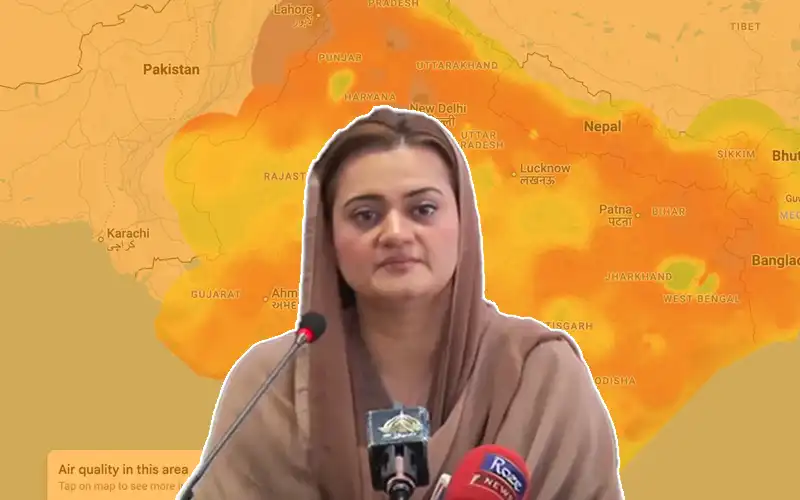
Senior Punjab Minister Marriyum Aurangzeb has claimed that polluted winds from India are drifting into Pakistan, worsening air quality in several cities of Pakistan.
In her latest statement, the senior minister stated that during Diwali celebrations, heavy use of firecrackers in Indian cities, including New Delhi, Chandigarh, Ludhiana, and Patiala, polluted the air, which later intensified the ongoing smog situation in Pakistan’s Punjab.
“The polluted winds from Indian cities, including New Delhi, Chandigarh, Gurdaspur, Ludhiana, and Patiala, are drifting into Pakistan’s Gujranwala, Multan, and Bahawalpur,” she said.
In a move to tackle air pollution, the Punjab government has implemented strong measures, including the use of smog guns in highly polluted areas.
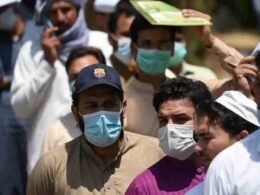
The minister stressed that citizens should keep vehicle and house windows closed throughout the day and made it mandatory for bike riders to wear masks.
READ: Karachi air quality updates: Check AQI readings of your area
Aurangzeb mentioned that a slight improvement in air quality may occur between 1 pm and 5 pm, though a light haze is expected to persist during the afternoon despite clearer skies.
She reaffirmed that the provincial administration is committed to combating the smog crisis, with continuous water sprinkling operations and active deployment of smog guns across Lahore and other impacted regions.
On Sunday, Lahore was ranked the second most polluted city globally based on air quality, according to air quality monitoring platform IQAir.
The Air Quality Index (AQI), which gauges the concentration of pollutants like fine particulate matter (PM2.5), coarse particulate matter (PM10), nitrogen dioxide (NO2), and ozone (O3), showed Lahore’s AQI at a very unhealthy 189.
An AQI above 150 is categorized as “unhealthy,” and readings above 200 are considered “very unhealthy.” Delhi, with an AQI of 212, ranked first.
Moreover, PM2.5 levels in Lahore were recorded at 109 micrograms per cubic meter (μg/m³), which is 21.8 times higher than the World Health Organization’s recommended annual limit for PM2.5 exposure.
These tiny particles, measuring 2.5 micrometers or less in diameter, can easily enter the bloodstream when inhaled, posing significant health risks.