







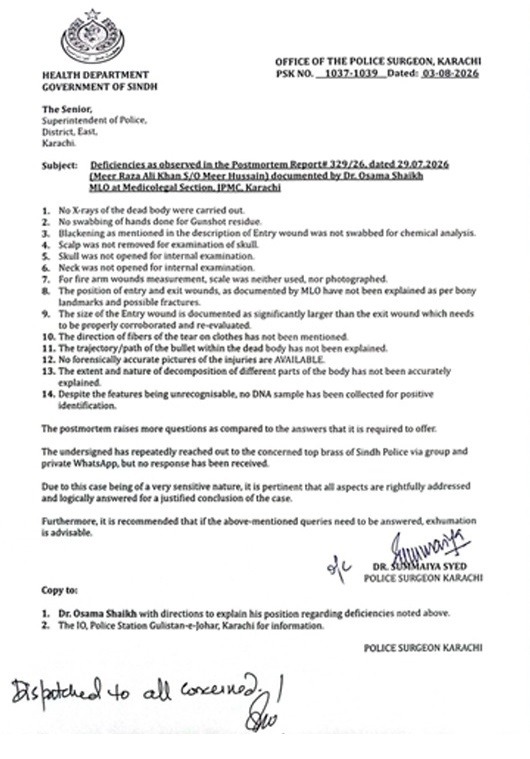
Police Surgeon Dr. Samia Syed has identified 14 deficiencies in the post-mortem report of slain Wafflix co-owner Mir Raza Ali, raising fresh questions over the forensic examination conducted following his death.
Follow Times of Karachi on Google News and add as a preferred Source on Google
Dr Samia has written to the SP District East, outlining what she described as shortcomings in the post-mortem examination conducted by Dr Usama Sheikh.
According to the letter, several forensic procedures were either not conducted or were not properly documented in the report.
No X-Ray or Gunpowder Residue Test
Dr Samia said X-rays of Mir Raza Ali’s body were not conducted, despite the importance of radiological examination in cases involving firearm injuries.
She also raised concerns that chemical analysis of gunpowder residue around the bullet entry wound was not performed.
The police surgeon said these examinations could have provided additional forensic information relevant to determining the circumstances of the shooting.
Skull and Neck Examination Not Conducted
According to Dr Samia’s letter, the internal examination of the skull and neck was also not carried out.
She said the absence of these examinations represented another gap in the post-mortem process that required clarification.
The observations come amid an ongoing investigation into whether Mir Raza Ali was murdered or died by suicide.
Concerns Over Injury Documentation
Dr Samia also questioned the way injuries were documented during the post-mortem examination.
She said no measurement scale was used while documenting the injuries and that the photographs taken during the examination did not meet the required forensic standards.
Also Read: Mir Raza Ali Case, Karachi Police Chief Offers
Exhumation for Fresh Post-Mortem
She further noted that the report did not provide a proper description of the bone characteristics of the bullet entry and exit wounds.
According to the police surgeon, the report also did not clearly document the nature and extent of decomposition of the body.
Difference in Entry and Exit Wounds
Another concern highlighted by Dr Samia involved the reported measurements of the firearm injuries.
She pointed out that the entry wound was reported as significantly larger than the exit wound, saying the difference required further examination and verification.
The direction and nature of the bullet wound have previously emerged as important questions in the investigation.
No DNA Sample Despite Identification Concerns
Dr Samia also raised concerns regarding the identification of the deceased.
According to her letter, Mir Raza Ali’s face was reportedly in an unrecognisable condition, yet no DNA sample was collected to establish identity through forensic testing.
She said the absence of DNA sampling raised further questions about the completeness of the forensic examination.
Fresh Questions in Mir Raza Ali Investigation
The latest concerns come as investigators continue examining the circumstances surrounding Mir Raza Ali’s death.
His body was found in Gulistan-e-Johar after he went missing from Karachi. Police have been reviewing CCTV footage, mobile phone data, forensic evidence and statements from people connected to the case.
The investigation has also involved questions over a weapon holster recovered from the crime scene and the whereabouts of the firearm allegedly linked to the incident.
Mir Raza’s family has maintained that he was murdered and has rejected the possibility of suicide.
Dr Samia’s latest observations add to an ongoing disagreement over the medical evidence in the case.
Earlier, she had said photographs of Mir Raza Ali’s body appeared inconsistent with some findings in the post-mortem report.
Follow the Times of Karachi channel on WhatsApp
Karachi police chief AIGP Azad Khan, however, said the post-mortem report was prepared by the concerned Medico-Legal Officer (MLO) and that police had relied on the official medical report during the investigation.
Azad Khan also said that if the family requests another examination, the body could be exhumed for a fresh post-mortem.
The latest allegations regarding the 14 deficiencies have not, by themselves, established the cause or manner of Mir Raza Ali’s death.
Further forensic examination and an official response from the relevant medical authorities will be important in determining whether the alleged shortcomings affected the findings of the original post-mortem.