




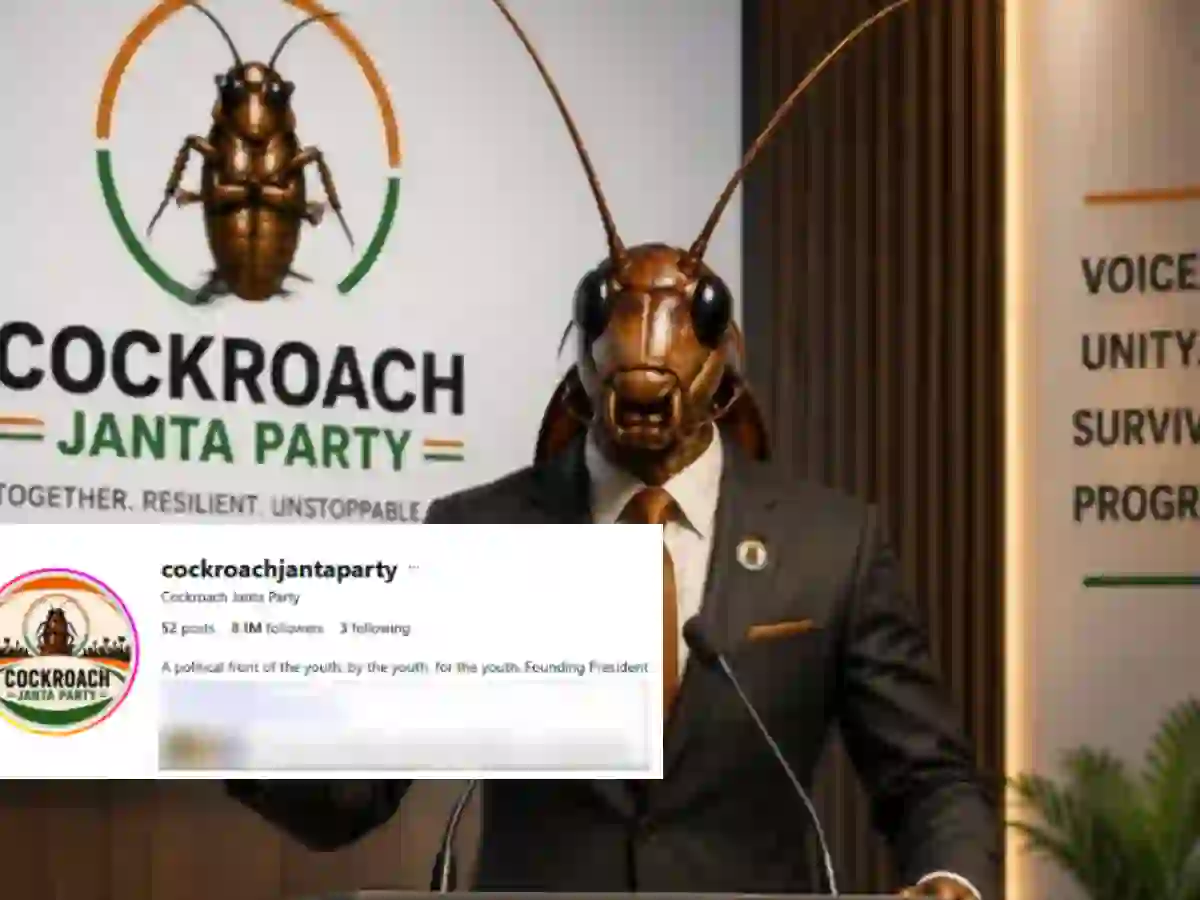
A satirical online political movement dubbed the ‘Cockroach Janta Party’ has rapidly gained traction across India after controversial remarks by India’s Chief Justice Surya Kant triggered outrage among young social media users and activists.
The movement emerged after the chief justice, during an open court hearing last week, compared some unemployed youth and activists to “cockroaches” and “parasites,” comments that quickly went viral online and drew widespread criticism.
Chief Justice’s Remarks Trigger Online Outrage
Speaking during court proceedings, Chief Justice Surya Kant said that some unemployed individuals become social media activists and “start attacking everyone.”
The remarks sparked a wave of backlash, particularly among Gen Z users already frustrated by rising unemployment, inflation, and political polarisation in India.
Although the chief justice later clarified that his comments were aimed at individuals obtaining fraudulent degrees and not at Indian youth in general, criticism continued to intensify on social media platforms.
Satirical ‘Cockroach Janta Party’ Emerges
The controversy inspired 30-year-old public relations graduate Abhijeet Dipke to launch the satirical “Cockroach Janta Party,” a play on the ruling Bharatiya Janata Party (BJP).
Dipke first floated the idea on social media platform X with the post: “What if all cockroaches come together?” The post quickly gained attention, prompting him to launch dedicated social media accounts and a website for the movement.
Within days, the party’s Instagram account amassed millions of followers, while hundreds of thousands of users reportedly signed up through an online registration form.
Youth Frustration Fuels Momentum
The online campaign appears to have resonated strongly with young Indians facing economic uncertainty and limited employment opportunities.
According to available labour data, unemployment among graduates in India remains significantly higher than among non-graduates, despite millions entering the workforce annually.
Political observers say the movement reflects broader frustrations among young citizens who increasingly use satire and internet culture to express dissatisfaction with mainstream politics and governance.
Opposition Figures and Activists Join Conversation
Several opposition politicians and activists publicly engaged with the movement online, further amplifying its visibility.
Retired bureaucrats, lawyers, and social commentators also described the campaign as symbolic of growing frustration over shrinking space for dissent and increasing pressure on activists and independent voices in India.
Prominent lawyer and activist Prashant Bhushan said the controversy reflected “deep-rooted prejudice” against youth and activists.
Satire as Political Expression
The “Cockroach Janta Party” presents itself as a humorous but pointed critique of political and social conditions in India.
Its online manifesto uses satire to address issues such as unemployment, media influence, and governance. The movement describes itself as a “political front of the youth, by the youth, for the youth.”
Digital analysts say the rapid rise of the campaign demonstrates how internet-driven political satire is increasingly shaping public discourse among younger generations.
Movement Continues to Expand Online
Despite initially beginning as a joke, the movement’s founder says the response has turned it into a broader platform for political expression and youth frustration.
Social media campaigns linked to the movement continue to trend online, while debates over freedom of expression, unemployment, and political accountability remain at the centre of public discussion in India.