







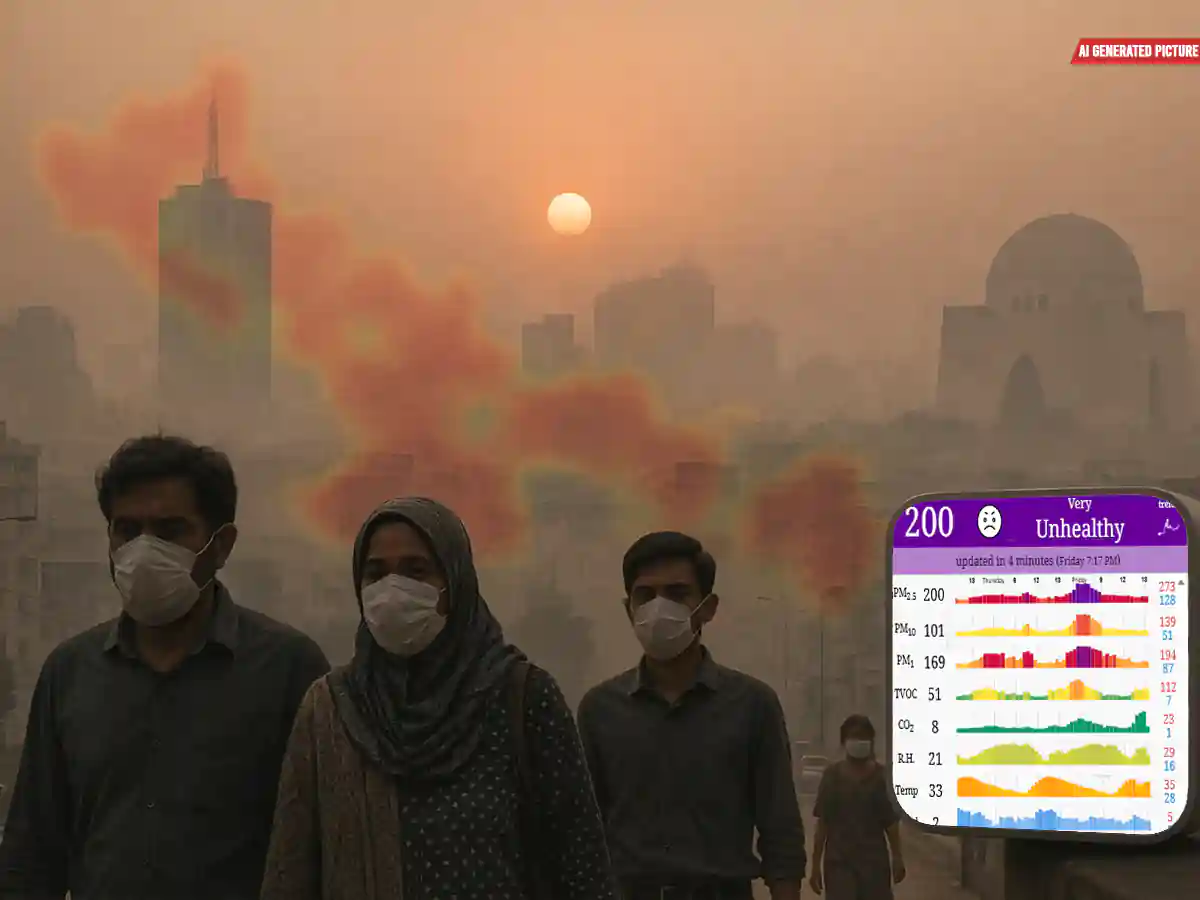
The levels of air quality remained unhealthy in Karachi, raising serious health concerns, according to the latest air quality index report updated Friday at 07:17 PM.
The latest air monitoring reports recorded PM2.5 concentrations ranging between 138 and 199 micrograms per cubic meter in different areas across Karachi.
The Urban Resource Center in Jamshed Town and Asif Gulistan-e-Johar in Gulshan District reported the highest readings, both recording PM2.5 levels of 200, which fall in the “Very Unhealthy” category.
Similarly, G3 Engineering Consultants in Karachi District recorded a reading of 199, while NED University City Campus in Saddar Town reported 185.
Other monitoring points across the city also revealed severe pollution levels.
Agha Khan University IED in Gulshan-e-Iqbal registered 171, the Orangi Pilot Project in SITE Town 172, and Engr Muzaffar Sir in Malir District 175.
To stay informed about current Karachi Air Quality, visit TOK Weather Page
In North Nazimabad, the Aman Khan Kaka Khail station measured 176, while the Climate Action Center and Urban Unit Karachi in Jamshed Town showed readings of 168 and 165, respectively.
Even the relatively lower readings, such as 138 at the Solid Waste Management site in Keamari Town, remain well above the World Health Organization’s (WHO) safe threshold of 15 µg/m³
These elevated PM2.5 levels are categorized as hazardous by international health standards and can cause respiratory and cardiovascular issues with prolonged exposure.
Visit Times of Karachi website for the latest news-related content
Health experts are urging citizens, especially those with preexisting health conditions, to take precautions such as wearing masks, limiting outdoor activity, and using air purifiers indoors.
How many categories are there to measure Air Quality?
AQI 0–50: Good
The air quality is considered excellent, with minimal or no risk to public health. There are no necessary precautions for the general population.
AQI 51–100: Moderate
Air quality is generally acceptable; however, there may be a slight health concern for a small number of individuals who are unusually sensitive to air pollution. Active children, adults, and people with respiratory conditions like asthma should consider limiting prolonged outdoor activity.
AQI 101–150: Unhealthy for Sensitive Groups
Sensitive individuals, such as those with asthma or other respiratory issues, may begin to experience health effects, although the general population is unlikely to be affected. It is advised that active children, adults, and those with respiratory conditions limit extended outdoor exertion.
AQI 151–200: Unhealthy
Health effects may begin to affect everyone, with sensitive groups potentially experiencing more serious symptoms. Active children and adults, and people with respiratory illnesses should avoid prolonged outdoor activity, while others—especially children—should reduce outdoor exertion.
AQI 201–300: Very Unhealthy
This range signals emergency-level health warnings. The entire population is more likely to experience adverse health effects. Those with respiratory conditions and active individuals should avoid all outdoor activity, while everyone else, particularly children, should limit time spent outdoors.
AQI 300+: Hazardous
Air quality is extremely poor, posing a serious risk to health for everyone. A health alert is in effect, and all outdoor exertion should be avoided by the entire population.