





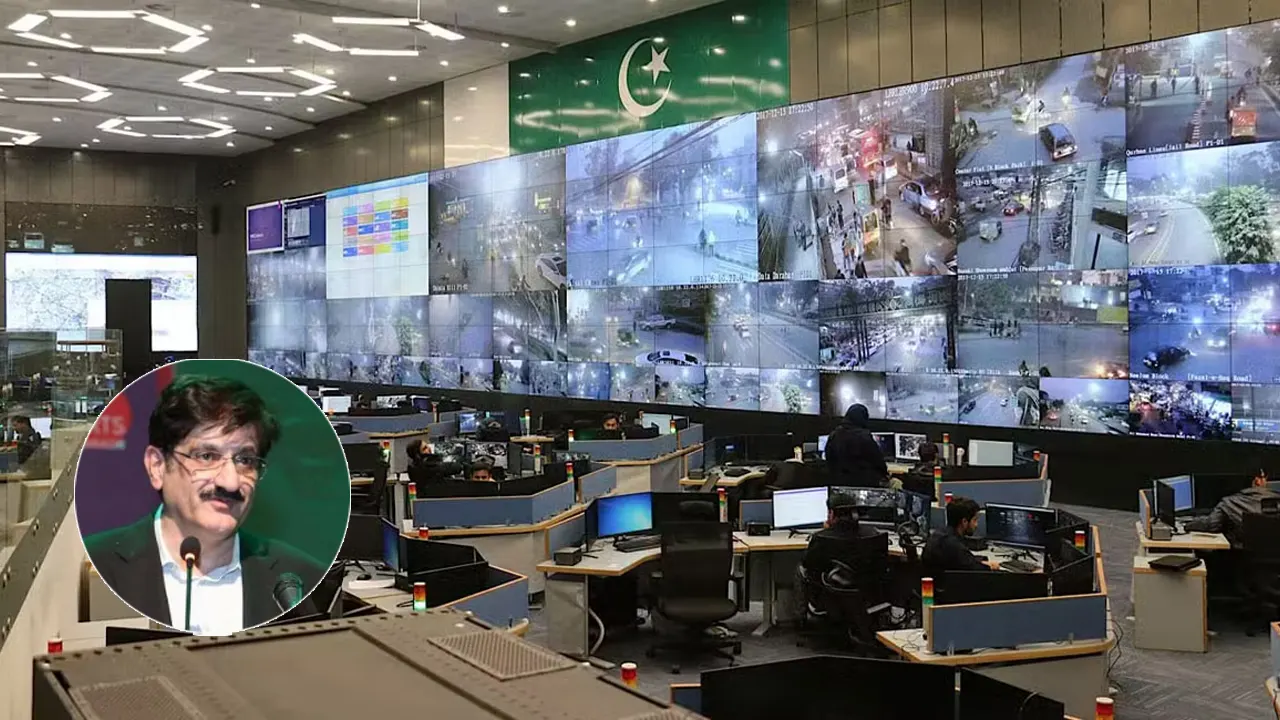
Sindh Chief Minister Syed Murad Ali Shah has approved a revised Rs189.75 million operation and maintenance plan for the Karachi Safe City Project, directing authorities to improve surveillance operations and ensure that modern technology delivers better public safety.
Follow Times of Karachi on Google News and add as a preferred Source on Google
The six-month maintenance arrangement will begin on January 1, 2027, while the overall annual financial ceiling has been set at Rs213.03 million, including spare parts and optical fibre charges.
The decision was taken during a meeting of the Sindh Safe Cities Authority (SSCA) at the CM House on Tuesday. The meeting reviewed the project’s progress, operational performance, financial requirements and institutional structure.
The Chief Minister stressed that the project should support effective policing, faster crime detection, vehicle recovery and stronger protection for citizens rather than remain limited to surveillance infrastructure.
Karachi Safe City Project: 1,300 Cameras Installed in Phase I
During the meeting, Director General Sindh Safe City Sarfraz Shaikh briefed the Chief Minister on the project’s first phase.
Installed by the National Radio and Telecommunication Corporation (NRTC), Phase I includes:
- 300 surveillance pole sites
- 1,300 cameras
- 18 Points of Presence (PoPs)
- A dedicated Data Centre
- A Network Operations Centre
The system uses surveillance technology and automated number plate recognition (ANPR) to support police operations, identify vehicles and provide digital evidence for investigations.
Murad Ali Shah directed the authority to ensure uninterrupted operation and professional maintenance of cameras, communication networks, control rooms and other surveillance facilities.
Safe City System Helps Trace 1,631 Vehicles
The meeting reviewed the project’s operational performance between January and October 2026.
According to the briefing, the system helped trace and hand over 1,631 vehicles to the relevant authorities. It also facilitated the handover of 84 wanted persons to law enforcement agencies and provided 642 instances of digital evidence to investigating formations.
The authority received 751 evidence-search requests from 23 different formations, of which 642 were facilitated.
Other operational figures included:
- 408 vehicle-arming requests processed
- 32 person-arming requests processed
- 52 vehicles traced through arming alerts
- 14 government vehicles handed over to police stations
These figures highlight how surveillance footage, digital records and automated vehicle identification can assist police investigations.
Cameras Help Police Solve Robbery and Recover Stolen Vehicle
The meeting was also informed about several cases in which the Safe City system supported police operations.
According to the briefing, surveillance footage and automated number plate recognition helped police:
- Solve a house robbery in Gulistan-e-Johar.
- Apprehend suspects allegedly involved in robberies while impersonating police officers.
- Recover a stolen vehicle within two hours and 15 minutes.
- Trace and intercept a vehicle wanted by a court.
The Chief Minister appreciated the reported results and directed Sindh Police and the Safe Cities Authority to improve coordination.
He said surveillance technology should increasingly support crime detection, timely police response, vehicle recovery and evidence-based investigations.
Sindh CM Approves 275 Positions for Safe Cities Authority
The meeting also approved an organisational structure comprising 275 positions to strengthen the authority’s administrative and technical capacity.
The proposed structure includes:
| Department | Positions |
| Administration and Management | 48 |
| Command and Control | 97 |
| Mobile Surveillance | 112 |
| Technical and ICT | 18 |
| Total | 275 |
Murad Ali Shah stressed the need to recruit professionally qualified staff, particularly in cybersecurity, artificial intelligence, software development, network engineering and digital forensics.
Recruitment will take place in phases, depending on available funds.
The Chief Minister also approved recruitment for three specialised technical positions:
- Chief Technology Officer (CTO)
- Chief Information Security Officer (CISO)
- SOC Analyst / Digital Forensics and Incident Response Specialist
He directed the authority to hire an HR company to manage recruitment for these positions.
Rs213.03 Million Annual Financial Ceiling Set
The Chief Minister approved the revised six-month operation and maintenance proposal of Rs189.75 million, with an overall annual financial ceiling of Rs213.03 million.
He directed that the maintenance agreement should ensure transparency, financial discipline and measurable performance.
The agreement must also include monthly verification of services, deductions for failure to meet agreed standards and no escalation in fixed costs.
The arrangement is intended to ensure that surveillance equipment and supporting infrastructure remain operational and properly maintained.
Phase II and Divisional Safe City Projects Reviewed
The meeting also reviewed progress on earlier decisions concerning the expansion and institutional development of the Safe Cities Authority.
These included:
- Approval of the Phase-II PC-I by the Provincial Development Working Party.
- Recruitment and notification of service regulations.
- The authority’s Rs575 million budget for the 2026-27 financial year.
- Provision of emergency response vehicles.
- Proposals for establishing Safe City projects in other divisions of Sindh.
The Chief Minister directed relevant departments to complete pending decisions on time and improve coordination with Sindh Police.
Karachi Safe City Project to Focus on Public Safety
Concluding the meeting, Murad Ali Shah said the Karachi Safe City Project must develop into a fully functional public safety and law enforcement system.
He stressed that its success should be measured through safer communities, stronger police response, effective investigations and greater public confidence in law enforcement.
The Chief Minister directed the Sindh Safe Cities Authority to maintain high operational standards and ensure that its technology and infrastructure produce practical benefits for Karachi residents.