


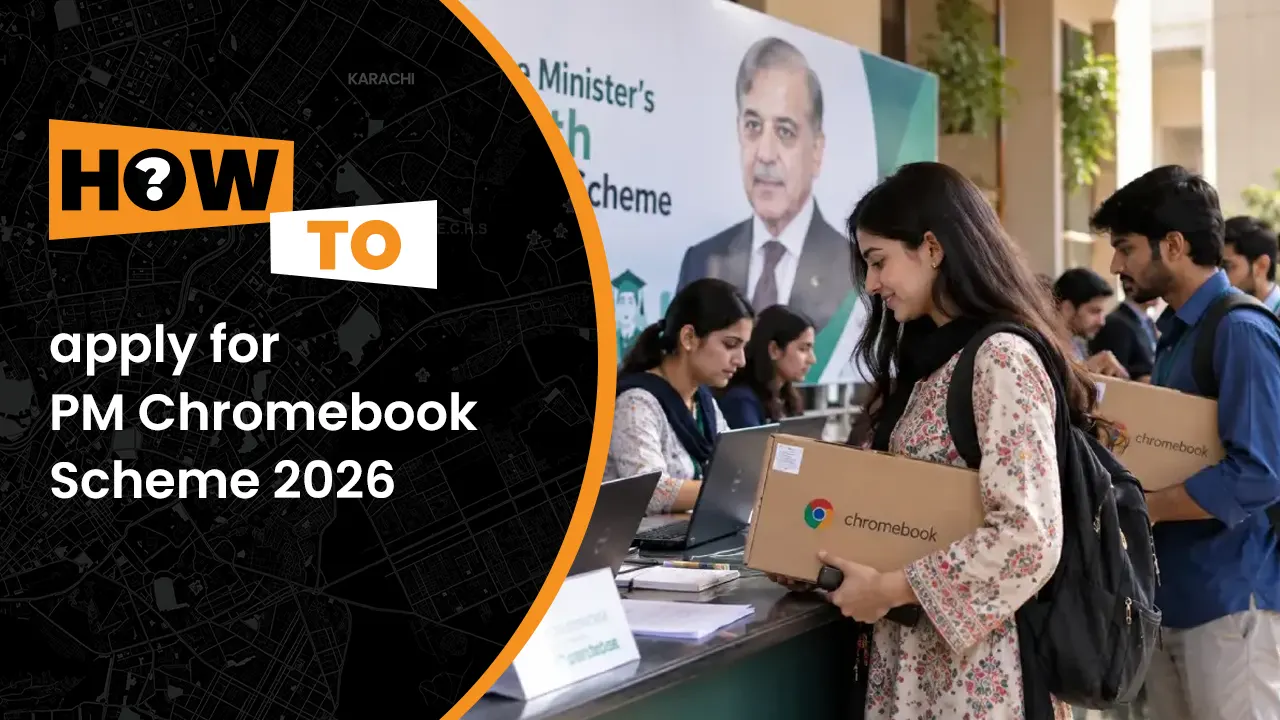
The federal government has announced plans to distribute 500,000 refurbished Chromebooks to high-performing Grade 9 students across Pakistan over the next three years under the Prime Minister’s Youth Chromebook Scheme.
Follow Times of Karachi on Google News and add as a preferred Source on Google
The initiative aims to improve access to digital learning for students who may not be able to afford a laptop. It is being implemented by the Ministry of Federal Education and Professional Training (MoFEPT) in collaboration with the Prime Minister’s Youth Programme.
The scheme will cover students in public schools, eligible private schools supported through provincial education foundations and registered religious seminaries, subject to the prescribed eligibility and verification requirements.
Who Is Eligible for the PM Chromebook Scheme?
According to the education ministry’s stated criteria, students must meet the following requirements to qualify for consideration:
- They must be enrolled in Grade 9.
- They must have secured at least 50% marks in their latest Secondary School Certificate Part-I (SSC-I) results.
- Their examination results must be verified through the relevant examination board and the Inter Boards Coordination Commission (IBCC).
- Their school enrolment and institutional affiliation must be verified.
Students from public schools and private schools funded through provincial education foundations are included in the scheme. Students of registered madaris may also qualify, with their records to be verified separately through the Directorate General of Religious Education.
Note: Meeting the minimum marks requirement does not automatically guarantee a Chromebook.
How Will Students Be Selected?
Officials say the scheme is designed to distribute Chromebooks on merit rather than through recommendations.
Students will be ranked according to their latest SSC-I results, with the relevant examination boards and IBCC responsible for verifying academic records and helping prepare merit lists.
Provincial education departments and education foundations will confirm students’ enrolment and institutional affiliation.
The selection process will continue within each province or region, examination board and academic stream until the relevant quota is filled.
Once the merit lists are finalised, each Chromebook will be linked to its intended recipient through its serial number. Officials say the records will be checked against the student’s merit position, enrolment, institutional affiliation and delivery information.
Province-Wise Chromebook Distribution Quota
The scheme envisages distributing 500,000 refurbished Chromebooks across Pakistan over three years. The allocations provided by officials are as follows:
| Province or region | Allocated Chromebooks |
| Punjab | 181,090 |
| Sindh | 85,925 |
| Khyber Pakhtunkhwa | 51,170 |
| Balochistan | 31,815 |
| Islamabad | 100,000 |
| Azad Jammu and Kashmir (AJK) | 25,000 |
| Gilgit-Baltistan | 25,000 |
| Total | 500,000 |
Under the proposed distribution formula, 80% of devices allocated within each province or region will go to school students, while the remaining 20% will be reserved for madaris students.
Among school students, the allocation will be divided between academic streams, with 70% going to science students and 30% to arts students.
How Will Chromebooks Be Delivered?
The government says the distribution process will include verification and monitoring at several stages.
After the merit lists are approved, devices will be assigned to verified students and dispatched directly by courier. A central monitoring system is intended to track dispatches, deliveries, unsuccessful delivery attempts and receipt confirmations.
An apex-level committee will provide strategic oversight, while MoFEPT will lead the national rollout in coordination with provincial governments. Provincial authorities will appoint focal persons to support implementation.
Officials have also outlined arrangements for repair and maintenance through a contracted firm after the first year of delivery.
These measures are intended to reduce errors, improve transparency and ensure that devices reach the students selected under the scheme.
How Can Students Submit Complaints?
Grievance redressal committees are planned at examination board and provincial or regional levels to address complaints during selection, verification and delivery.
According to officials, students and families will be able to raise concerns involving:
- Merit rankings and selection results.
- Inclusion in or exclusion from merit lists.
- Incorrect examination records.
- Enrolment and institutional affiliation checks.
- Chromebooks that have not been received.
Students should follow official announcements from their examination boards and education departments for details of the complaint process, deadlines and required documents.
When Will Applications Open?
The information provided about the scheme describes its eligibility criteria, provincial allocations and proposed distribution process. However, it does not specify an official application opening date, a registration portal or a final distribution schedule.
Students and parents should therefore wait for formal instructions from MoFEPT, the Prime Minister’s Youth Programme and the relevant provincial education authorities before submitting personal information or documents.
They should also be cautious of unofficial websites or individuals demanding money in exchange for registration or selection.
How the Scheme Could Help Students
Access to a personal computer can help students use digital textbooks, attend online classes, develop computer skills and explore educational resources beyond the classroom.
By including school students and eligible madaris students across Pakistan, the scheme aims to extend digital learning opportunities to a wider range of learners.
Its impact will depend on transparent merit-based selection, accurate records, timely delivery and effective maintenance arrangements. If implemented as outlined by officials, the programme could help students who have performed well academically but cannot afford their own devices.